
Trump Tariffs on India Risk Pushing Key U.S. Ally Toward Russia and China
By Mohammed Affan
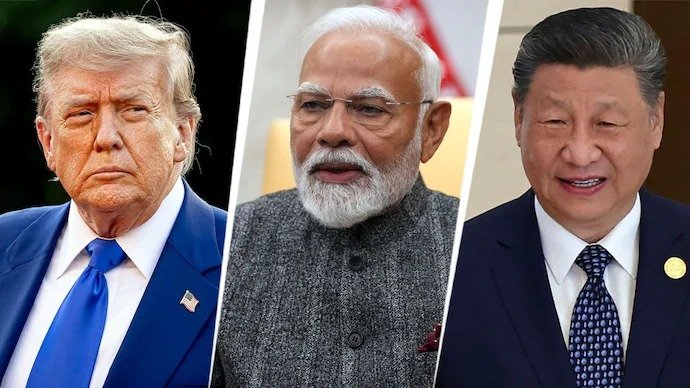
On 6 August 2025, U.S. President Donald Trump imposed 50% tariffs on Indian goods, citing New Delhi’s continued purchases of Russian oil. The move, which former U.S. National Security Advisor John Bolton called an “enormous mistake”, risks straining a cornerstone of Washington’s Indo-Pacific strategy at a time when China is rising and Moscow is deepening its alignment with Beijing.
In response, India is signalling that its strategic independence remains non-negotiable. National Security Advisor Ajit Doval’s recent meeting with Russian President Vladimir Putin; visits to China by Defence Minister Rajnath Singh, External Affairs Minister S. Jaishankar, and Doval himself; and news of Prime Minister Narendra Modi’s planned participation in the Shanghai Cooperation Organisation (SCO) summit later this month all point to New Delhi’s unwillingness to be boxed into any single camp.
Washington’s gamble is clear: use economic pressure to shape India’s strategic choices. But New Delhi’s answer may be equally clear, charting its own course in an increasingly multipolar world.
Historical and Economic Context: India’s Strategic Balancing Act
India’s foreign policy has long been defined by a careful balancing act between Moscow, Beijing, and Washington. Ties with Russia run deep, rooted in Cold War–era defence cooperation and sustained by shared positions in global forums, energy partnerships, and technology exchanges.
Relations with China, while strained by a contested border and periodic military stand-offs, are underpinned by robust trade and deep integration into manufacturing supply chains. With the United States, India has evolved from decades of mutual suspicion to a strategic partnership anchored in shared democratic values, defence cooperation, and converging Indo-Pacific interests.
This policy of strategic autonomy, shaped in part by the Non-Aligned Movement during the Cold War, remains central to New Delhi’s decision-making.
Tariffs, Trade, and Security
Washington’s 50% tariff on Indian goods is ostensibly aimed at pressuring Moscow over its invasion of Ukraine. But its impact on the war is uncertain; what is more predictable is the damage to U.S.–India relations.
If Washington treats New Delhi as collateral damage in its Russia policy, it will find India less inclined to cooperate on China. Lisa Curtis, former Deputy Assistant to the President and Senior Director for South and Central Asia at the U.S. National Security Council, in an interview with NDTV said, “India is an important partner of the United States. We do have strategic convergences when it comes to the China threat, and President Trump is risking that long-term strategic partnership by his tactics.”
From Beijing’s perspective, any rift between India and the United States opens space to recalibrate its South Asia strategy, potentially softening its posture toward New Delhi to reduce U.S. influence in the region.
For Moscow, the tariffs are seen as an own goal for Washington, accelerating India’s tilt toward greater economic and strategic cooperation with Russia.
As NYT reported, “Trump’s calculus appears clear-force Russia to negotiate by isolating its buyers. But in turning up the heat on India, he risks pushing the worlds largest democracy into tighter alignment with Beijing and Moscow.”
The consensus among analysts across capitals is clear: economic coercion may generate short-term leverage, but it risks long-term damage to the geopolitical balance in Asia.
India’s Expanding Economic Leverage
India, now the world’s fourth-largest economy, is projected by the IMF to grow at 6.4 percent in both 2025 and 2026, up from estimated 6.2%, and is on track to overtake Germany and become the third-largest economy by 2027–2028. Foreign direct investment remains robust, with provisional inflows hitting USD 81.04 billion (Provisional) in FY 2024–25, a 14% jump from the previous year, and equity inflows in the first nine months of FY 2025 up a record 27%. Services attract the lion’s share, followed by software, hardware, and trading.
Over the decades, India has embedded itself in global supply chains, from pharmaceuticals to technology, while expanding its manufacturing base, competitive services sector, and agricultural exports. The U.S. and China remain its top trading partners, while trade with Russia has grown steadily, placing it among the top ten, a distribution that underscores why New Delhi cannot afford a binary alignment.
In an increasingly multipolar world, India’s economic weight gives it the latitude to engage each major power where interests converge, and step back when they diverge.
The Real Test for Washington
The U.S. tariff move may be aimed at Moscow, but it lands squarely in New Delhi’s calculus of self-interest. The question is no longer whether India will side with the U.S., Russia, or China, but whether Washington can accept a partner that acts on its own terms.
Indian diplomatic veterans have often noted, strategic autonomy is not merely a slogan; it is the product of geography, history, and the hard-earned lessons of a turbulent international order.
The coming months will show whether the United States sees India as a junior partner to be managed or as an equal to be persuaded. In an era where alliances are fluid and great-power competition is multi-directional, that choice could define the trajectory of U.S.–India relations for years to come.